Re-uploads
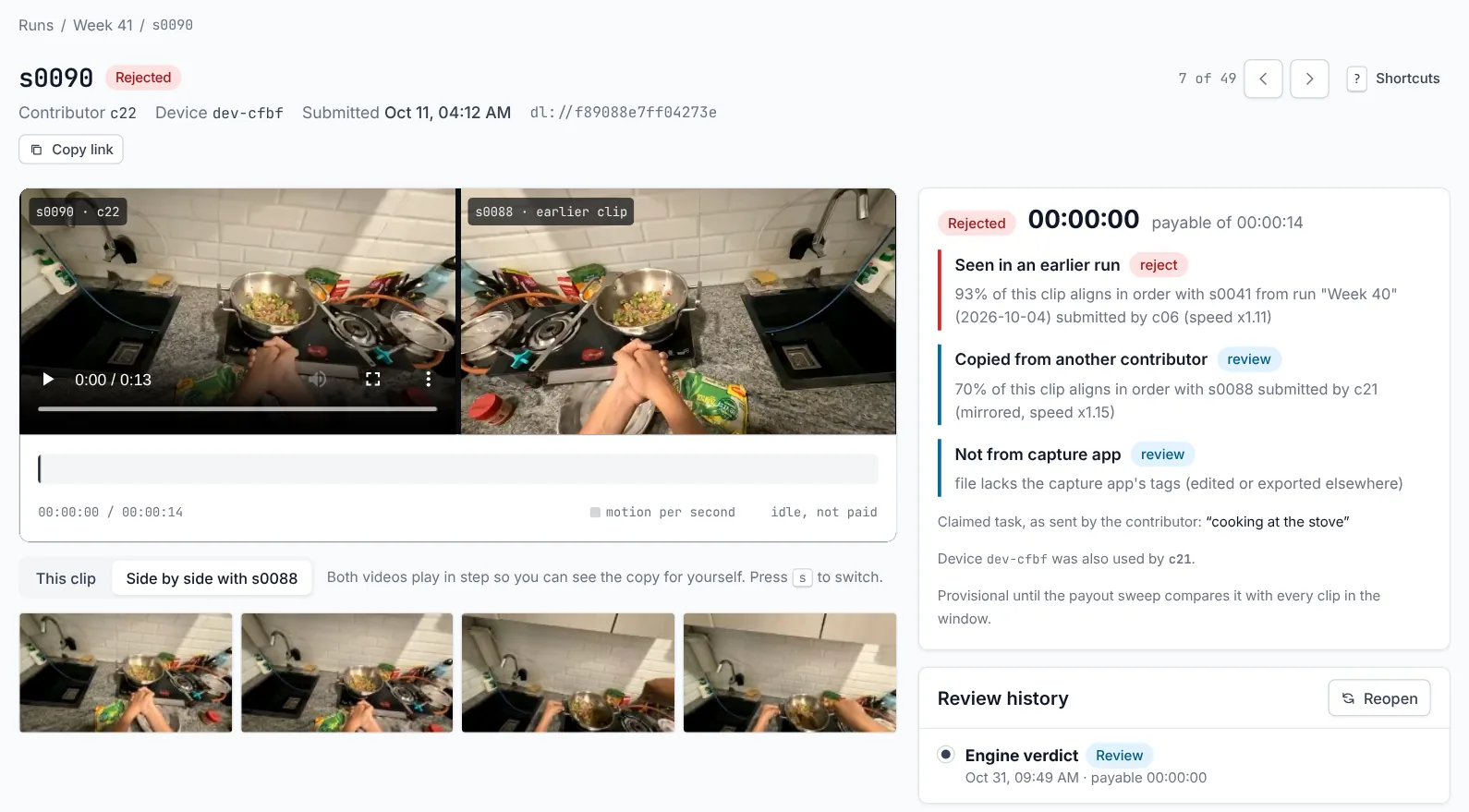
An old clip, submitted again. Re-encoded or retagged, it gets paid for twice.
Truehands checks first-person video before anyone gets paid for it, and collects verified video for robotics labs. Every clip gets a verdict, the exact seconds it should be paid for, and the evidence behind it.
Robotics labs and data collection companies pay people by the hour to film their hands at work. They pay per accepted hour and reject footage by hand today. Some of what arrives was never worth paying for.
An old clip, submitted again. Re-encoded or retagged, it gets paid for twice.
Someone else's clip under a new account: mirrored, cropped, sped up or played backwards.
Real work stretched with still footage, a clip looping its own footage, or video slowed by repeated frames.
Footage lifted from open datasets and passed off as new.
Who it is for
You pay contributors per accepted hour of first-person video and reject footage by hand today.
People film chores and work for you, and you need to know which hours to pay for.
You need to know what you are paying for: copies across vendors, public datasets, idle padding.
Every clip gets a verdict, the exact seconds it should be paid for, and the evidence behind it. A problem with one clip never fails a run.
Paid in full. Paid seconds are counted from the video stream itself.
Idle time, loops and slowed footage are cut from pay. The rest is paid.
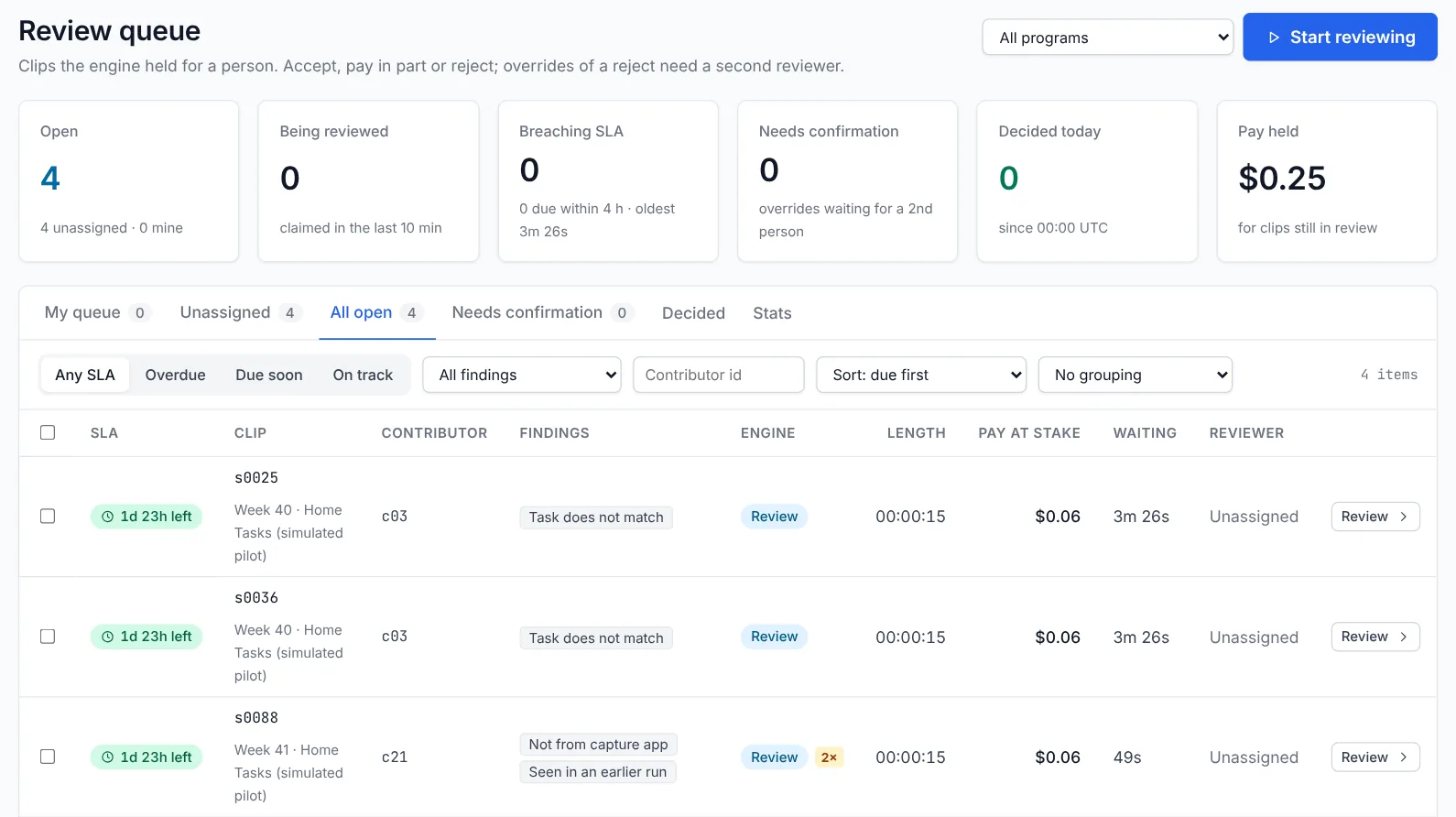
A person decides, with the evidence in front of them. Pay waits.
A copy, a public dataset, a sensor log that contradicts the video, or a forged signature.
One command in your data pipeline or CI, and a console for the people who review and pay.
$ truehands run --program home-tasks --manifest week41.csv \
    --wait --fail-on reject
Run run_72af299c132b queued: 49 clips (2 files were already on the server)
  REJECT   s0063      c14        00:00:15  sensor_mismatch
  PARTIAL  s0068      c12        00:00:27  idle_time
  REJECT   s0086      c11        00:00:15  self_duplicate, reused_capture_timestamp
  …
  VERDICT    CLIPS    FOOTAGE    PAYABLE
  accept        30   00:07:30   00:07:30
  partial        1   00:00:27   00:00:16
  review         2   00:00:30   00:00:00
  reject        16   00:03:55   00:00:00
  total         49   00:12:22   00:07:46

  gate      fail_on=reject  FAILED  16 clips at reject · exit 1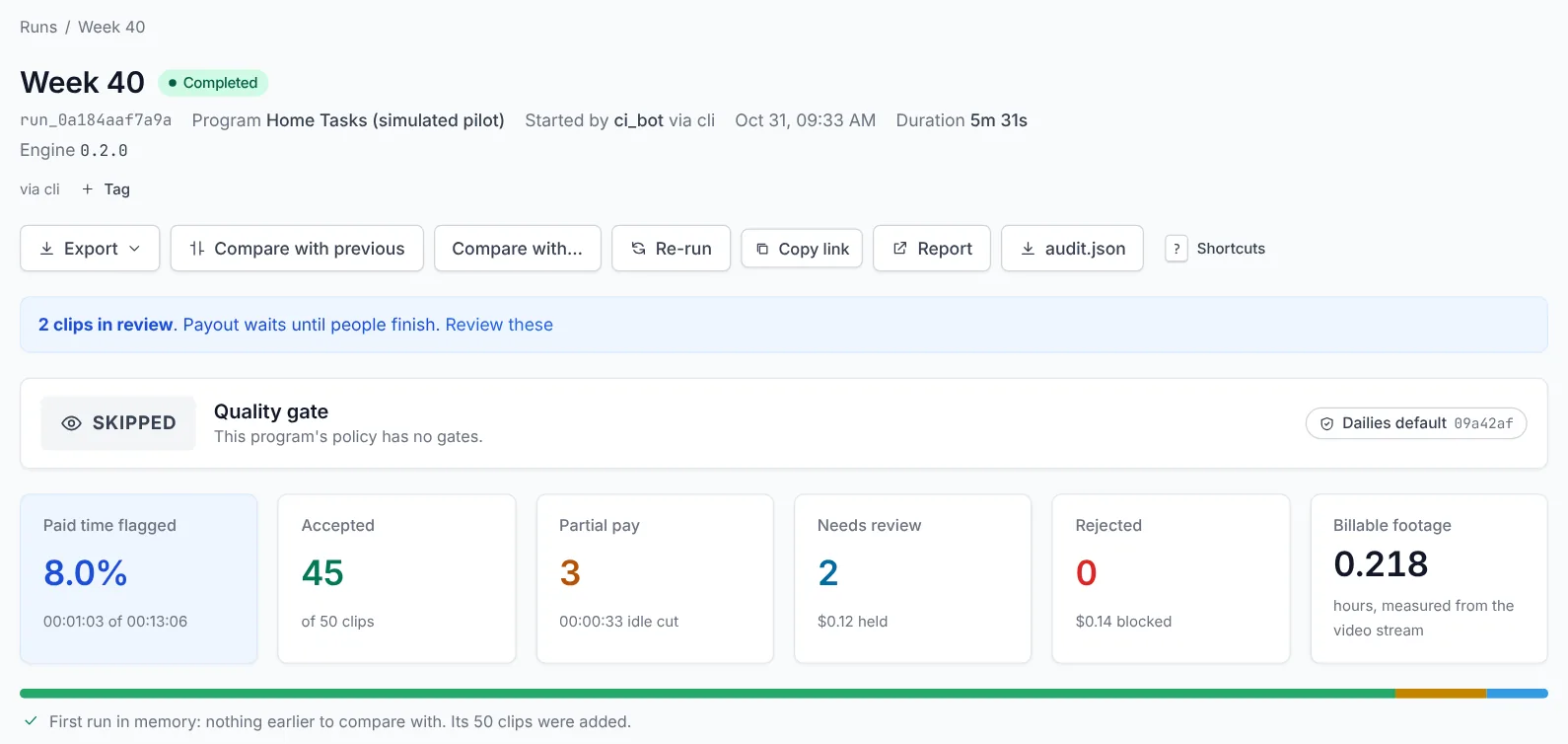
Hosted by us. Upload from a script or CI and follow each run in the console.
The same engine, deployed in your account, so footage never leaves it.
Each clip passes through the same five steps. Every flag carries what a reviewer needs to check it: matched frame pairs with timecodes, the motion trace, the gyro-versus-video chart.
Only MP4 or MOV with one H.264 or HEVC video stream. Paid seconds are counted from the stream, never from the container.
stream hash · paid secondsFrame embeddings twice a second, also for mirrored frames, motion per second, and camera rotation from optical flow.
embeddings · motion · rotationCopies across every earlier run, public datasets, padding, the claimed task, the sensor log and the signature.
findings with evidenceYour policy turns findings into a verdict and the exact seconds to pay. The decision trace is kept with the clip.
accept · partial · review · rejectEdge cases go to a person. Paying a flagged clip takes two approvals. Results flow out as payout batches, webhooks and exports.
payout batch · webhook · exportA file that cannot be read is rejected and billed nothing. A step that fails inside the engine holds the clip for review instead of failing the whole run.
The benchmark is built from open datasets. It is split by recording into a calibration half and a held-out half. Thresholds are set on the calibration half only; the numbers below come from the held-out half unless they say otherwise.
66%, 95% CI 58–72%.
1 of 182 across both halves. Our first version: 29 of 182.
per hour of video, CPU only.
Our first version wrongly rejected 9% of one factory crew's honest work: it read repetitive work at one workstation as re-uploads. That case is now a test every release must pass.
About a third of the attacks on the benchmark get through. These are the known gaps.
Grayscale, strong noise, half-frame crops, picture-in-picture. Such a copy looks less like its source than honest repeated work looks like itself.
a copy-detection descriptor, not a thresholdA gyro log derived from the picture matches it perfectly. No check on pixels can tell it apart.
signed captureHeavy re-encoding blends the duplicated frames, so neither pixel differences nor optical flow see the repeat.
signed capture with a signed durationWhat this does not prove. We wrote the attacks ourselves, from open footage; the benchmark contains no real fraud, and 182 honest clips is a small sample. The demo program in our screenshots is simulated too, and we do not quote its results as accuracy. A pilot on your footage is the real measurement.
Status: our first pilot collection is being organized. Labs can reserve pilot hours to their spec. We have no hours in stock and no catalog yet.
The engine is built to run where the footage already is, to trust nothing it is handed, and to show reviewers only what they need.
Deploy the engine inside your own AWS account with our Terraform module. Footage never leaves it.
No internet gateway, no NAT, and an allow-list DNS firewall. A script checks that the network is sealed.
Faces in evidence frames are blurred. In Truehands Data, faces of bystanders are blurred too.
An enrolled device signs the video stream and the sensor log with Ed25519. A forged signature is rejected.
Model files load only when their hashes match the published values. Nothing is downloaded at run time.
The engine ships as a container image signed by digest. It runs as an unprivileged user on a read-only root.
Intake is strict: the engine reads only MP4 and MOV with one H.264 or HEVC video stream, within size, length and resolution limits. Anything else is rejected before decoding and billed nothing.
In Truehands Cloud, footage is deleted 30 days after its last run, or sooner if your owner sets a shorter period. Verdicts, reasons, review decisions and payout records are kept, and you can back every run up to your own bucket.
You see what the audit finds in your data before you pay anything. We share prices on a call.
No. We do not claim to tell generated video from real video by its pixels.
Signed capture is our answer: an enrolled device signs the video stream and its motion-sensor log with Ed25519 at capture time, and the audit checks that signature. A generated clip, or a sensor log computed from the picture, has no valid signature.
On our benchmark, built from open datasets, the held-out half: 110 of 168 attacks caught (66%, 95% CI 58–72%), and 0 of 89 honest clips flagged. Across both halves, 1 of 182 honest clips was flagged.
Those attacks are ours, not real fraud. It will miss some fraud, and we publish what it misses. A pilot on your footage is how you find out what it catches in your programs.
That is the error we watch most closely. Our first version wrongly rejected 9% of one factory crew's honest work, because repetitive work at one workstation looked like re-uploads. That case is now a release test.
A mismatch between the claimed task and the footage only sends a clip to review. Edge cases go to a person with the evidence, and paying out a flagged clip takes two people.
Not if you run Truehands Audit inside your own AWS account. It deploys with a Terraform module into a network with no internet gateway, no NAT and an allow-list DNS firewall, from signed engine images. Footage never leaves your account.
A real slice of your footage and a manifest that lists the clips, contributors and claimed tasks. Motion-sensor logs help if you collect them: the sensor check needs them. The audit pilot is free for two weeks, and we report what we find.
Not from stock. Truehands Data is in pilot and our first pilot collection is being organized. Labs can reserve pilot hours to their spec; pilot orders start at 100 hours. See how Truehands Data works.
GitHub Actions, GitLab CI, Jenkins, CircleCI and Buildkite, and cron or Airflow. The truehands CLI exits non-zero when the gate fails, and can write JUnit reports.
Two weeks, a real slice of your footage, a report of what we find.